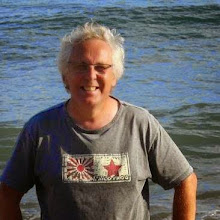
To tell you the truth, though I have lived here in Mundane for more than three months; it's only today that I realised just how exotic these days have been. My birthday was two days ago, 58 years of age, I am now irrefutably in my 'late fifties' and I feel that I have entered a new phase of life for reasons I think will soon become apparent. Gill, who always manages to buy me exactly the right birthday book and understands instinctively whatever my current state of mental disfunction might be, chose Paul Theroux's 'Tao of Travel', a miscellany of short extracts from a variety of travel writers chosen by the master of the art himself.
Though I am only part way through the book, a couple of things become immediately apparent. Travel is shown to be more an of attitude of mind rather than a change of place; it is the inner thoughts of travellers, musings on their journeys' vissictitudes and momentary triumphs that keep you hooked, not any vivid evocation of place or lame attempts at amateur socio-anthropology. Paul Thoreau prefaces the book with a section called 'The Importance of Elsewhere'. The phrase is taken from the title of Larkin's poem which perhaps more than anything else articulates the ambivalent nature of the traveller who can only truly find themselves whilst among strangers.
Lonely in Ireland, since it was not home,
Strangeness made sense. The salt rebuff of speech,
Insisting so on difference, made me welcome:
Once that was recognised, we were in touch
Their draughty streets, end-on to hills, the faint
Archaic smell of dockland, like a stable,
The herring-hawker's cry, dwindling, went
To prove me separate, not unworkable.
Living in England has no such excuse:
These are my customs and establishments
It would be much more serious to refuse.
Here no elsewhere underwrites my existence.
In the half century since the poem's publication, first through the spread of mass media, then over the last decade as the world becomes ever more 'wired' perhaps 'elsewhere' has diminished. Google Earth purports to makes nomads of all of us without the need to move from our seat; Facebook feeds our lives, thoughts and desires into an invisible algorithim then reflects them back repackaged as sales opportunities; at work we juggle face to face meetings with the demands of emails, texts and mobile calls; at home perhaps we glance from the hyper-reality of HD 3D TV or taking five from the vicarious, heroic violence of the latest FPS to click 'like' on a fautous video going viral on the other side of the globe. Where in all of this is our own unique 'road less travelled'?
So here is my contention, if elsewhere has become everywhere, then the disregarded, disconnected mundane may be the new exotic. Linkedin is ten years old today or so the breathless, bright eyed and bushy tailed promo video which fell into my inbox five minutes ago claims. Listen to it, 'Everything is local, everyone is right there. Imagine what we can do together?' What do those sentiments say? Purporting to be an inspirational call to collective endeavour, instead they send a shiver down the spine as you contemplate a world played out for the consumption of remote cyberpals, a world where solitude, privacy and estrangement have been all but eradicated. Blessed be the cheerleaders, for they have inherited the earth.
So, as a traveller I have decided to reject, at least for a while, seeking far-off lands and distant peoples. Instead I am going to haunt the disregarded streets where I live, walk to places where I used to drive, without a mobile phone, just me, a camera and the moment. I can do this because my circumstances have changed and I have more time to myself right now than at any time in my life. Being able to do nothing is whole new world. It feels strange, disturbing, luxurious and indulgent.
In practice what this led to was the creative project that I undertook as part of my MA dissertation. It involved a careful record of a journey down an obscure trunk road and an outburst of quasi-shamanistic utterances in a local country park. The evidence is here for anybody, or nobody to see.
The text of the poems became invisible, I used them as soundtracks for video mash-ups. So, just for the record, here they all are, words and everything..
Transcription of video readings:
Grin Low Haiku
1
Light
seeps through new leaves,
A
silvery trickle, words
rustle,
silence rains.
2
bright
green, Spring explodes -,
each
ribbon proclaims,
“There is magic in these woods!”.
3
So what if words go unread -
Birds sing ‘just because’ –
Is that not enough?
4
Not ‘just because’,
birdsong marks a territory,
like this utterance.
5
Birds (soar)
fields (open)
skies. (clear) unlike
pleasure,
there are no small freedoms.
6
Forever autumn here,
Pray for the fallen,
and those who remain,
bereft.
7
Un-ancient woods -
the duke's green-screen ensured
injustice seemed picturesque.
8
sun-brushed grasses,
a goose-down tussock, leaf-dappled;
love, lie here with me.
9
Lost in winter days -
dark paths, at dusk,
charcoal trees
silhouetted.
10
Unimaginable.
Summer’s gone
Its richness, a squandered plenitude.
A38 Sonnets
The golden age of
motoring
Pre-easyJet
they linked unlikely places –
Bodmin to
Mansfield, via Tewkesbury;
meandering
through England’s crowded spaces,
mementos
of an age unused to hurry.
Perhaps
it's all a myth - that RAC’s
roadside
patrols saluted passers-by;
content
inside their Hillmans, smiling families
sipped tea;
lay-bys were litter-free, July
though
blustery, always sunny. Now up-graded
to
would-be motorways, sat-nav defined,
a two
lane stretch comes as a shock. A faded
re-collection
flashes though my mind:
A sunset
I once glimpsed near Gravelly Hill-
lost
highways? - No, but roads to freedom still.
Ding dong, the fairy dances…
A yer ago
t’ day me Daddy died.
Back then
‘ahf the North’s exultin’, “Ding-dong
t’witch's
dead.” Soo as ah stood biside
‘is
grave, ah foond that foockin’ stewpit song,
wuz
janglin’ in me yed. Find that amusin’?
Ee
wuhdnov. Even‘ ow she kicked the booket
well
foxed im - were fer ahl ‘is cursin’, boosin’
a
soft-un, eed act ‘ard like , say –“juice foock it’’.
Am stood
‘utside schulgait, tis dressinoop day -
out ‘ops
me bairn, dun-up int fairy frock
wi’’clip-
on wings. Ah givs ‘er little spray
i Aldi daffs, an off t’is’ grave we
trot.
She lays
dahn boonch, an snapzer magic twaig
then
waeves ‘er tin-foil wond, anduzajaig.
Observed
from afar
All present and correct - a
small green space
well signed and fully risk
assessed: I park
the car, then walk-off
wondering - in some place,
on fuzzy screens, was my action marked?
But even unobserved I leave
a trace:
a snap-shot of a warning
notice; tree-bark
in close-up; floating with
world-weary grace,
a swan in monochrome. The
sky grows dark,
and now across the lake the
lights come on
in Kingsmill Hospital; its bland façade
ablaze – a grandiose neon
Mondrian.
Inside, a nurse completes a
record card;
auxiliaries mop up, then
wait to strip the bed.
They chat. A porter comes
to take the dead.
One small
step
Christmas morning – truly crap
without me,
birthdays marked by one
desultory kiss.
School-kids are taught
bugger-all about me,
I’m commonplace, a thing no
one would miss.
No ‘giant leap’ – like
fire, the internet
or wheel. I’m ‘one small
step’ in man’s ascent.
So why are all the evils
that beset
us blamed on me? I’m not
some malcontent,
Pandora turned the
key! I’m the place you’re
urged to think outside, yet
live within,
your house is me with
windows and a door.
Mine’s the last laugh, to
your eternal chagrin
I’m the fate that no-one
can outfox –
your final resting place –
a simple box.
Floods of
tears
The fallen warrior, I
understand
its stock iconography –
from pediment,
to museum, to cenotaph, a
band
of brothers bonded by
forced sentiment.
It’s just a statue. Why
then did my heart
stutter, when I noticed by
his ear
a single blood-dark
leaf? Behind the art –
the posture, I sensed a raw
feral fear.
Winter – rivers rise; the
bland, silvery flood,
storm-shredded sky, the
brittle saplings, black,
wind-blasted, howl at the
slaughter, the spilled blood.
Forever running towards you
up the track,
bare flesh napalm flayed, a
naked child –
exposed in terror, mouth
gaping, eyes wild.
Anecdote
of the cones
What did I expect – ‘a
paradise
of pitfalls’ or gradual
‘death of affect’?
A cul-de-sac, the half
-forgotten reprise
of dreams I never had. A
puddle reflects
the grey, inscrutable sky
and one black tree –
I peer in - no me. Perhaps
I’ve disappeared.
I’m being scrutinized, so I must be!
Does surveillance calm
everything we’ve feared?
Let’s stick to facts,
exec-detached suburbia,
blue bin day; across the drive
some fool placed
three traffic cones. The
dada prank perturbed our
bourgeois equipoise – the
culprits never traced-
we kept the cones, sensing
some faux apogee,
like Stevens’ famous jar in
Tennessee.
A38M - a
fable, c. 5014
The hunter halted,
whistling to his hound;
she trotted back, head
down, she’d lost the scent.
His boy caught-up, spotting
a mossy mound,
the hound and he sat down.
His father leant
upon his spear, gesturing
towards a crumbling column
that still stood tall above
the forest; “Here
once giants lived, so
old-ones say.” Their solemn
tale he quietly retold,
“They had no fear,
on silver wings they soared
above the clouds;
though far apart, they
spoke to one another–
made magic pictures talk.
But they grew proud
and sullied Gaia, angering
Sol, her brother.
From the sky he leapt, to
avenge the slight –
the giants burned like twigs
in smoldering firelight.
Aston Hall grotesques
They may be ‘stony-faced’ –
but hardly stern,
these monkey-men, this
woodwode-shaped grotesque;
Jacks-in-the-green with
horns like curled-up fern,
the woman, sensual, a full-lipped
arabesque.
Sculpted with skill, and
placed above each door
to ward off evil, or denote
a border,
they say to guest, or
casual visitor:
without - wildwood, within
- domestic order.
‘Compleated 1636’ a worn
plaque reads, Built just
before the Civil War
divided ancient loyalties,
England torn
apart, ten years of
bloodshed. No more
a greenwood spread beyond
the garden walls,
wilderness has fled, an
endless city sprawls.
Ancestral
Ground
The
victim of an infantile dark age
you sift through shards for clues. Prehistory
reveals an undecipherable page,
its archetypal script – a mystery.
Adrift in strangely convoluted dreams,
abandoned in some dear, familiar place
you sense that nothing now is what it seems,
your precious things all lost without a trace.
Impaled upon a broken blade of stone
the summer solstice sun, bloodied, crimson,
invokes the hopelessness of what is known.
More potent than our mythic risen son
a shaman gibbers in a tongue of fire:
how love was lost, consumed by raw desire.
A letter
to Janey
Do you ever imagine us
apart?
We would survive,
independent, strong,
sad for a while, of course,
but in our heart
accepting, oddly, we never
did belong.
Easier to write, than say -
I fold the note
into my diary. I’ll hide it
in a drawer,
and if you find it, claim
it just a quote
from some old poet, about
his slut, his whore.
I watch outside the window
a ragged crow
arise on raucous wings,
then disappear
into the twilight. I arise
and go
upstairs, right now I need
to feel you near,
tiptoe down your spine,
sere finger tips,
peck your slender neck with
trembling lips.
Amrita
fled
“Tomorrow will be seven
months, but still
I can’t believe he’s gone.”
Amrita fled,
furious, demeaned,
uncertain if she’d said
too much, seemed over eager
to fulfill
the neighbours need to pity
her. In here,
amongst his orchids –
Satyrium Nepalense,
Peristylus Duthei – he felt
so near;
In each frail floweret, his
presence,
a fading scent. A summer
shower thrums
incessantly on greenhouse
roof. She tries
to summon-up his smile.
Instead what comes
to mind, a snapshot, a
stranger’s pensive eyes,
her grandma’s words, “a
catch…well qualified”
she, just a girl, excited,
terrified.
Instinctive
sense of artifice
Imagine his mind this neatly
planted parkland,
each vista composed consciously, its loveliness
carefully husbanded; across the lawn peacocks strut
with instinctive sense of artifice.
each vista composed consciously, its loveliness
carefully husbanded; across the lawn peacocks strut
with instinctive sense of artifice.
The mansion crumbles, from a dry fountain, worn gods
spout silence; leaves flutter, small birds and tall grasses
shadow plotted pathways; through trees a starry pool
glitters in the sunlight. Wilderness encroaches.
He walks in the high walled garden:
through wrought gates, distant dusk blue hills promise
impossible freedom; but here is his landscape,
amongst unkempt roses trained across the trellis,
and sharp tang of marjoram and honeysuckle,
velvet scented, he paces the ruined terrace.
The A38 Sonnets project never really got beyond a 'pilot project'. Pressure to produce the 20,000 words of academic burbling squeezed the time I had to complete my sojourn down the A38. It remains work in progress, I will, perhaps, one day complete it.

No comments:
Post a Comment
Note: only a member of this blog may post a comment.